
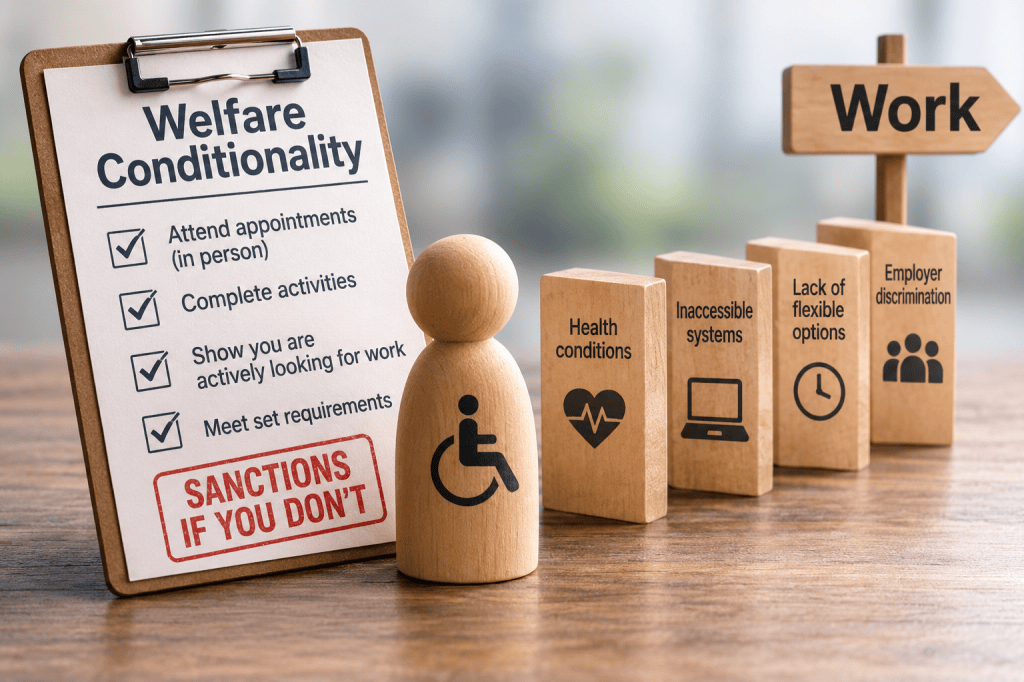
The barriers to engaging in employment support are often the same barriers to employment itself
Research by the Institute for Employment Studies and Trussell highlights how welfare conditionality fails to account for disability. But the barriers disabled people face when engaging with employment support are often the same barriers keeping them out of work.
At a time when the Government is under pressure to reduce the welfare bill, and rising numbers of people are out of work for health reasons, calls for greater benefit conditionality are once again gaining momentum.
The argument is familiar: requiring people to engage more actively with employment support, backed by the threat of sanctions, will help move them into work.
But a new report by the Institute for Employment Studies (IES) and Trussell, Employment support and conditionality for people facing hardship, provides an important reason to pause.
Drawing on the lived experiences of people facing labour market marginalisation and navigating conditionality systems, the research highlights the significant barriers people encounter when trying to engage with employment support. Around 64% of participants had a long-term health condition or disability.
Their experiences reveal a welfare system that too often fails to recognise ill-health and disability, or understand that disability is created by the interaction between ill-health or impairment and the social and material environment.
And this is not simply a problem with the way employment support is delivered. It reflects the same barriers that disabled people face in the labour market itself.
Disability discrimination is embedded in conditionality
The report describes how conditionality requirements often take little account of people’s health conditions, fluctuating capacity or the environmental barriers they face to attending and taking part in mandatory activities.
Mandatory in-person appointments, for example, can be difficult or impossible for people who experience barriers to travel or who cannot reliably attend at a fixed time due to a fluctuating health condition. Jobcentre environments and work preparation activities may be inaccessible or unsuitable for people with particular impairments.
Participants also described advisers who misunderstood or disbelieved their health conditions, reflecting a lack of training in disability, neurodivergence, fluctuating conditions and mental health.
These encounters can undermine people’s confidence and self-belief. Not to mention that stringent compliance regimes consume energy that could otherwise be directed towards work, while sanctions and the threat of sanctions exacerbate anxiety and financial hardship.
Even the digital platforms that must be used to document job search search activities can be inaccessible for people with visual and other impairments.
Taken together, these findings point to a system that locates the problem within the individual, rather than recognising the social and environmental barriers they face. The failure to understand disability and make reasonable adjustments to work preparation activities is not incidental to the operation of conditionality. It is built into the way the system expects welfare recipients to engage.
The barriers don’t stop at the Jobcentre
But there is a bigger point here.
The barriers people encounter when engaging with employment support are often the same barriers that prevent disabled people from accessing and sustaining employment.
My own research for employment support charity Astriid, Making Employment Work, explored the experiences of disabled people seeking employment. The research drew on a sample of jobseekers with long term health conditions who were willing and engaged in our support services.
Their experiences highlighted two major barriers: the lack of suitably flexible jobs available to them, and employers’ lack of understanding of long-term health conditions.
Disabled people may be willing and motivated to work, but that does not mean suitable opportunities are available to them.
The IES report states that a lack of flexible, part-time, remote or hybrid roles can make it difficult for people to find work that accommodates their health needs and fluctuating capacity. And that employers’ perceptions of risk, alongside a lack of understanding of long-term health conditions, can create barriers during recruitment as well as within the workplace.
These are not problems that can be resolved by requiring people to attend more appointments, undertake more work preparation activities or demonstrate greater compliance with benefit conditions.
The very people being required to engage more intensively with employment support may be facing the same lack of flexibility, understanding and reasonable adjustments in the workplace that makes finding and sustaining a job so difficult.
This is why it is important to join the dots between the experiences of people navigating welfare conditionality and the experiences of disabled people seeking work.
Increasing conditionality will not address these barriers
We have been here before.
Previous efforts to increase conditionality and sanctions have not delivered the transformation in disability employment that successive governments have promised.
My own research, among others, demonstrates that where compulsion is presented as the primary route into work for disabled people and people with health conditions, it risks worsening poverty, hardship and health, without addressing the underlying barriers to employment.
The IES and Trussell Trust report is helpful in offering a different starting point: understanding the barriers people face and designing employment support around their circumstances, rather than expecting people to comply with requirements that may be inaccessible or inappropriate.
Its recommendations include flexible appointment times and locations, advisers trained in disability inclusion and trauma-informed practice, accessible communications and alternatives to digital journals and in-person meetings.
It also recommends that sanctions should be a last resort, only after barriers have been investigated and reasonable adjustments offered, with safeguards against hardship.
These are important recommendations for disabled people. But the report also highlights the need for wider definitions of work-related activity that recognise wellbeing as progress, and for success to be measured by sustainable employment rather than simply getting people into any job.
Crucially, it calls for employer engagement to create flexible, part-time, remote, hybrid and accessible roles.
That last point matters. Employment support cannot succeed if it focuses exclusively on changing the behaviour of jobseekers while leaving the barriers within the labour market untouched.
From conditionality to removing barriers
There is a wider lesson for the debate about welfare reform.
Requiring people to engage in a conversation with employment support may be a positive step towards a more proactive system. But engagement in itself is not a route to employment.
As Elizabeth Gerard argued in a blog for the Learning and Work Institute recently:
“Requiring engagement in a conversation is a positive step towards a more proactive system. But it will only succeed if it is accompanied by […] a labour market capable of offering real opportunities.”
That is particularly important for disabled people.
A system that expects people to demonstrate their willingness to work must also recognise the barriers that prevent them from doing so. That means accessible and appropriate employment support, reasonable adjustments, and employers willing and able to offer jobs that accommodate different health conditions and working capacities.
The findings of the IES and Trussell Trust report show that disability discrimination is not simply a barrier encountered when applying for a job or negotiating adjustments with an employer. It can also be embedded in the very systems intended to support people into work.
And the barriers to engaging with those systems are often the same barriers that keep disabled people out of employment itself.
If the Government is serious about increasing employment among disabled people and people with health conditions, the priority should not be to increase conditionality. It should be to remove the barriers — both within employment support and within the labour market.
I’m Catherine Hale. My work examines how employment and social security systems operate in practice for disabled people, particularly those whose experiences and support needs are poorly understood or accommodated by existing policy.

