
Flex Plus: A Disability-Centred Model of Flexible Working
Flex Plus is a model of flexible working designed around health and disability. It brings together flexibility over hours, time and place—enabling people to work in ways that are sustainable, inclusive and productive.
Rethinking work for health and disability
Work is still organised around an “ideal worker”: someone who can work full-time, reliably, and with consistent energy from 9 to 5 and beyond.
But that model no longer reflects the reality of the workforce.
Many disabled people, and particularly those living with long-term, fluctuating or energy-limiting conditions, are excluded from work not because they lack skills, motivation or ambition, but because work is not designed in a way we can sustain.
Flexible working is often presented as the solution. But in practice, it rarely goes far enough, and it is generally not designed around health and disability.
Flex Plus is a model of flexible working that centres disabled people’s experience.
What is Flex Plus?
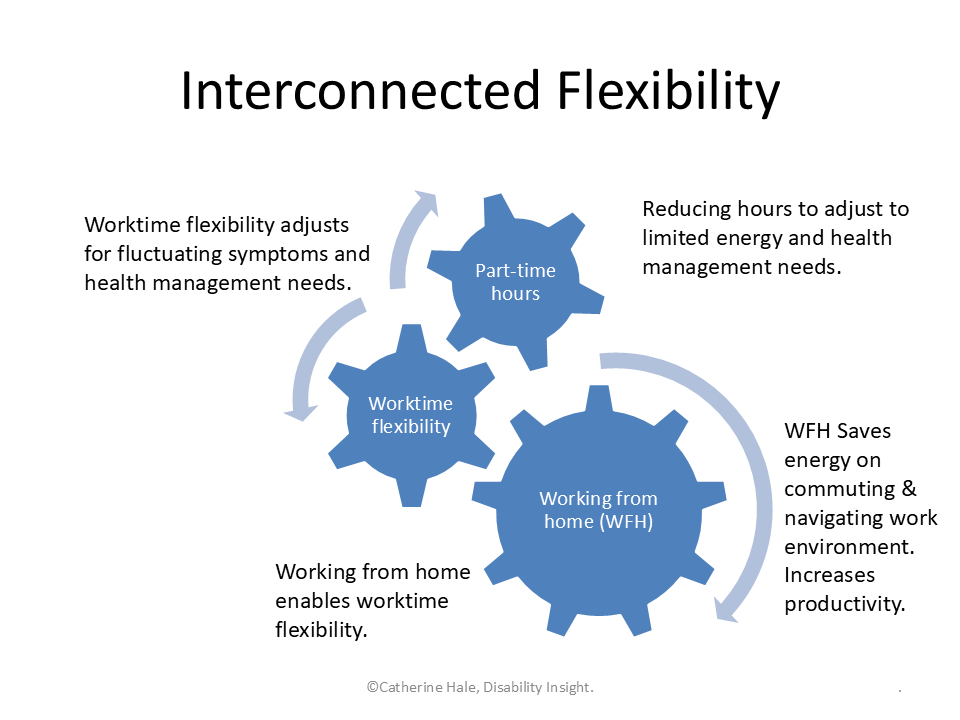
Flex Plus is a disability-centred model of flexible working.
It brings together three forms of flexibility that, in combination, enable many disabled people to better navigate work and health:
- Reduced hours (part-time or adjusted workloads)
- Flexibility over time (control over when and how work is done)
- Flexibility over place (including working from home)
These are not “nice-to-have” lifestyle preferences. They are often the difference between being able to work and being excluded from the labour market altogether.
Flex Plus is not a rigid formula or a one-size-fits-all solution. It is a way of understanding how time and location flexibility interact with each other. It is a way of designing flexibility around health, impairment and sustainability.
Where does Flex Plus comes from?
The Flex Plus model grew out of lived experience.
I was excluded from the labour market for over 20 years because my chronic illness could not be accommodated within conventional ways of working. Later, through independent research and policy work, I realised how widely shared this experience is.
Through the Chronic Illness Inclusion Project, I worked with people with a wide range of long-term conditions with various levels of inclusion in the world of work. What emerged was a consistent pattern. Many people had a strong desire to work and contribute, and many had partial capacity for work. But they could not find jobs that could be adapted to their energy levels or fluctuating symptoms.
The barrier was not motivation or “inactivity”. It was job design.
Later, working with the employment support organisation Astriid, I saw the same disconnect. People were actively looking for work, but not applying for available roles. When we asked why, the answer was clear: they were looking for jobs that offered flexibility over time and place, and they couldn’t find them.
Across the research I did, one insight became clear:
Flexible working is not one thing. For many disabled people, it is a combination of flexibilities that need to work together.
Flex Plus is a way of naming and describing that reality.
Why Flex Plus matters
Flexible working is the most commonly requested adjustment by disabled employees. It is also strongly linked to whether people stay in work when their health changes.
Yet flexible working policies are rarely designed with disability in mind.
Most frameworks focus on family life, childcare and caring responsibilities and work–life balance.
But for disabled people, flexibility primarily about managing their health and support needs alongside work.
This includes:
- conserving limited energy
- adapting to fluctuating symptoms
- managing treatment, rest and recovery
- working at times when energy is available
Without this, work becomes unsustainable.
At the same time, there is a clear mismatch in the labour market. Large numbers of disabled people need some form of Flex Plus working—but very few roles are designed or advertised in this way.
As a result, people are often described as “inactive” or “unable to work”, when in reality they are unable to work under current conditions.
What are the obstacles?
Research with employers at King’s College London showed that there is strong understanding of the need for Flex Plus, and real willingness to make it work.
But there are also consistent barriers.
These fall into three broad categories:
- Operational barriers
Some roles have genuine constraints around location or working patterns. - Cultural barriers
Norms about “how work is done” can limit flexibility, even where it is possible in practice. - Implementation barriers
Line managers often lack the tools, confidence or support to put flexible arrangements into practice.
Across all of these, one issue stands out:
Flexible working is still too often treated as a discretionary perk, rather than an essential enabler of performance for disabled employees.
The hidden gap: a two-tier system
Perhaps the most important finding from this work is the existence of a two-tier system.
In many organisations, flexible working, including elements of Flex Plus, can be negotiated by employees once they are in a role.
But at the point of recruitment, these arrangements are rarely available.
This creates a structural barrier:
- People already in work may eventually access flexibility
- Disabled jobseekers who need flexibility from the outset are locked out
This helps explain why so many people who want to work are unable to access suitable roles, and why employment support programmes struggle to bridge that gap.
A different approach to designing work
Flex Plus offers a way to rethink this.
It shifts the focus from fitting people into existing roles to designing roles that reflect how people can work sustainably.
It also reframes flexible working as:
- a core part of workforce health
- a tool for retention and inclusion
- and a foundation for good work in a changing labour market
While the model emerged from research with people with energy-limiting and fluctuating conditions, it resonates much more widely, including for people with mental health conditions, neurodivergence, and others whose capacity to work does not fit traditional patterns.
From insight to practice
Flex Plus is not just a concept. It is something organisations can apply.
I seek to work with employers, policymakers and organisations to:
- understand what Flex Plus means in practice
- identify where roles and systems can be adapted
- and develop approaches to recruitment, job design and management that make this possible
If you’re interested in how to implement Flex Plus in your organisation, you can explore practical guidance and next steps via this website soon.
 Disability Insight